Analysis of TE10 mode propagation in air-filled and alumina-loaded WR-90 waveguides
A compact HFSS study comparing cutoff frequency, guided wavelength, field confinement, and insertion loss for a standard air-filled guide versus a 96% alumina-filled configuration.
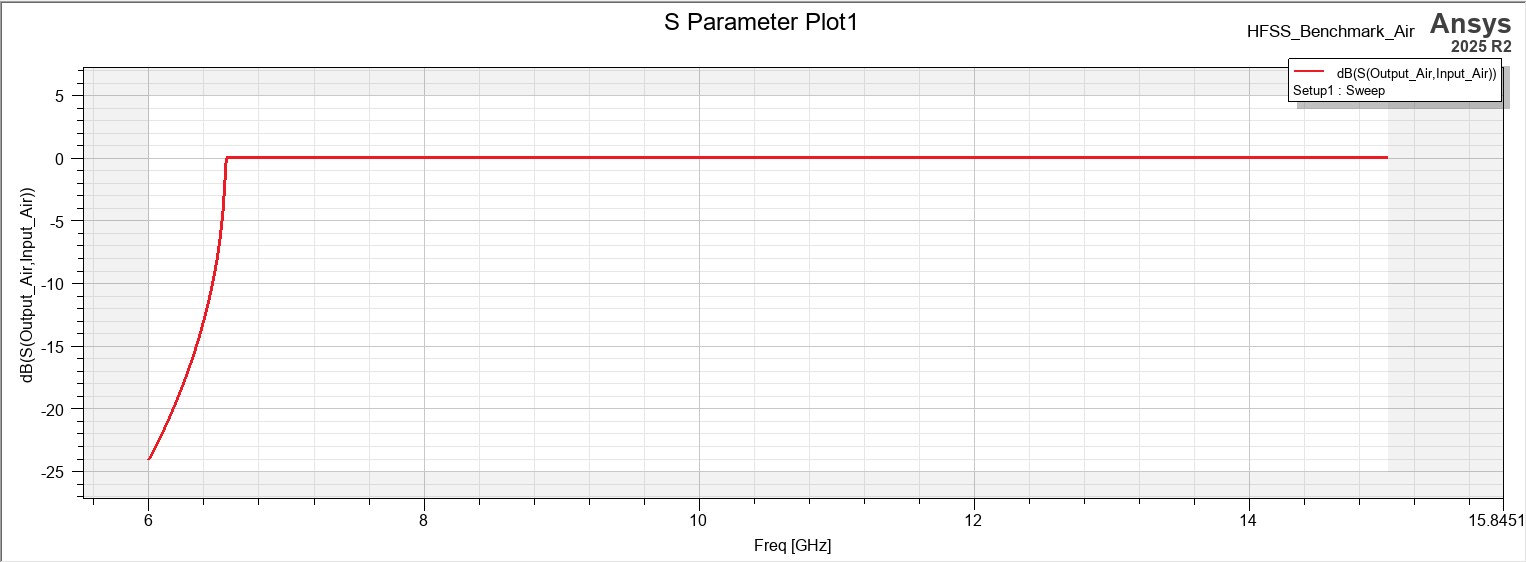
Air cutoff
6.56 GHz
Baseline WR-90 propagation threshold.
Alumina cutoff
2.19 GHz
Dielectric loading lowers the operating threshold.
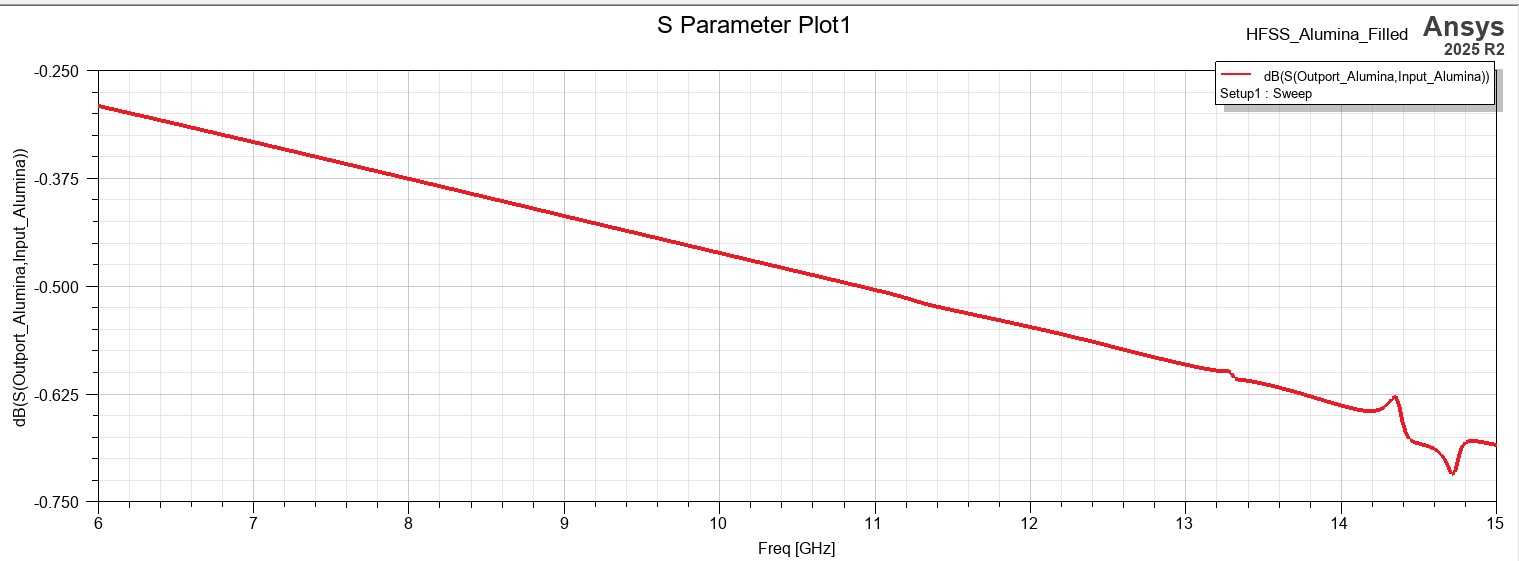
Measured loss
0.26-0.72 dB
Insertion loss range from alumina loss tangent.
Project completion date: November 9, 2025
Download full report (PDF)Waveguide theory
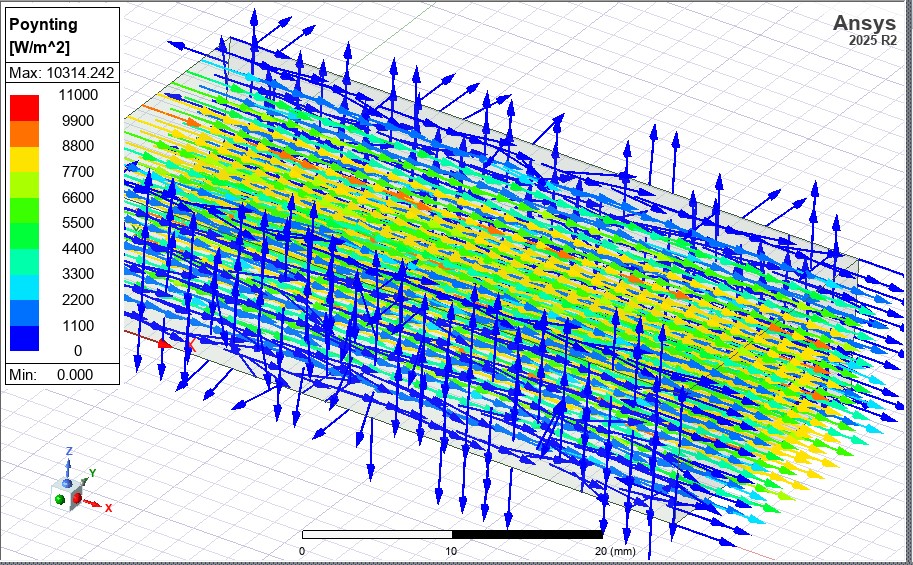
The project focuses on the dominant $TE_{10}$ mode in a WR-90 rectangular waveguide. The comparison isolates one design variable: replacing the air volume with 96% alumina to study how relative permittivity reshapes propagation behavior.
Engineering domain
High-frequency RF engineering, microwave theory, waveguide propagation, and electromagnetic field interpretation.
Core analysis
Cutoff frequency, guided wavelength, S-parameter response, field concentration, and dielectric attenuation.
Software used
ANSYS Electronics Desktop with HFSS for 3D electromagnetic modeling and post-processing.
HFSS simulation setup
Objective
The goal was to conduct a quantitative comparison of $TE_{10}$ propagation in a standard WR-90 waveguide and in the same geometry fully loaded with alumina. The HFSS setup evaluates how dielectric loading changes cutoff frequency, guided wavelength, field concentration, and insertion loss.
Project milestones
- Modeled both air-filled and alumina-filled WR-90 configurations against theoretical formulas.
- Compared $TE_{10}$ cutoff frequency using analytical relations and HFSS validation.




- Visualized E-field and H-field concentration for both material cases.
- Compared guided wavelength at 10 GHz to show dielectric loading impact.
- Quantified insertion loss through S-parameter post-processing in HFSS.
Field & S-parameter results
Cutoff shift
Alumina loading reduces cutoff from 6.56 GHz to 2.19 GHz, making the same physical guide behave like a lower-frequency structure.
Field confinement
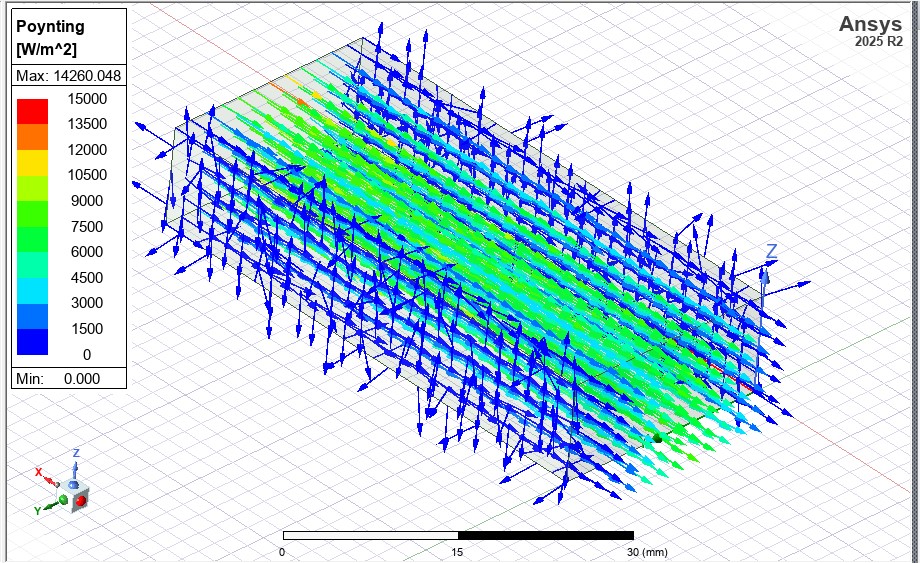
The high-permittivity region concentrates electric and magnetic fields, changing the spatial energy distribution inside the guide.
Loss trade-off
The alumina case introduces measurable insertion loss, quantified between approximately 0.26 dB and 0.72 dB.
Simulation gallery
Air-filled waveguide
Alumina-filled waveguide
Conclusion
The simulation confirms the expected electromagnetic trade-off: alumina loading enables a much lower cutoff frequency in the same WR-90 envelope, but it also increases field concentration and introduces dielectric loss.
- Cutoff frequency: Alumina lowered the cutoff frequency from 6.56 GHz to 2.19 GHz.
- Field concentration: Fields became more concentrated inside the high-permittivity material.
- Insertion loss: Dielectric attenuation was quantified at approximately 0.26 dB to 0.72 dB.
Future work
A logical next step would be to investigate a partially filled waveguide. Simulating a dielectric slab with variable thickness would help identify a practical compromise between miniaturization, field confinement, and insertion loss.