Transient Thermal Analysis for Process Optimization: A Comparative Study of Lumped Capacitance Modeling and Finite Element Simulation
Insertion Automatisée à Chaud d'Écrous dans des Composants en Polycarbonate
Rafi NASRALAH, ENSET Mohammedia (Dans le prolongement de l'expérience de stage SMCV)
Télécharger le Rapport Complet de l'Étude (PDF)
Énoncé du Problème
Le Problème Central
Le problème central abordé par cette recherche personnelle est l' quantifiable uncertainty du temps de cycle du processus d'insertion à chaud et le risque associé de dommages thermiques to the polycarbonate component. The fundamental question being answered is: "What is the temps réel et validé required for the brass insert nut to reach the optimal insertion temperature of $170\degreeC$ while stacked in the automated feeder?" This required replacing the simplistic, unreliable theoretical estimate with a high-fidelity numerical prediction. L'étude compare un calcul simplifié à paramètres localisés avec une simulation thermique transitoire sous ANSYS afin de juger le chronométrage du processus avec des hypothèses de transfert de chaleur plus réalistes. La comparaison qui en résulte soutient une stratégie de chauffage pratique pour le flux de travail d'insertion automatisée d'écrous introduit lors du stage chez SMCV.
Objectif de l'Étude
L'objectif principal de cette exploration est de déterminer le temps réel et validé required for the brass insert nut to reach the optimal insertion temperature ($\mathbf{170\degreeC}$) while stacked in the automated feeder.
Sous-Objectifs :
- Quantifier les failles analytiques : Mathematically derive the heating curve using the Lumped Capacitance Model (LCM) to establish a theoretical $t_{\text{LCM}}$.
- Modéliser la physique réelle : Develop a high-fidelity Transient Thermal FEA model in ANSYS explicitly accounting for 3D geometry and contact physics.
- Valider et optimiser : Compare numerical and theoretical curves to establish the validated minimum heating time.
Approche par Simulation FEA
Analyse Comparative : Théorie vs Simulation
Méthode 1 : Modèle à Paramètres Localisés (LCM)
A simplified theoretical approach assuming uniform internal temperature. Relied on an estimated effective heat transfer coefficient.
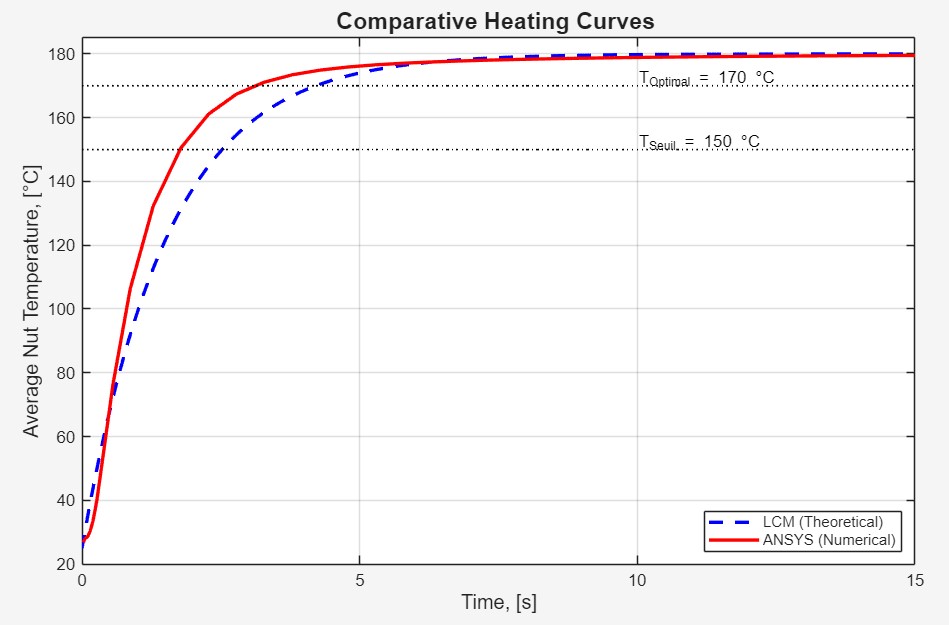
$t_{\text{LCM}} = 4.22\text{ s}$
Méthode 2 : Analyse par Éléments Finis (FEA)
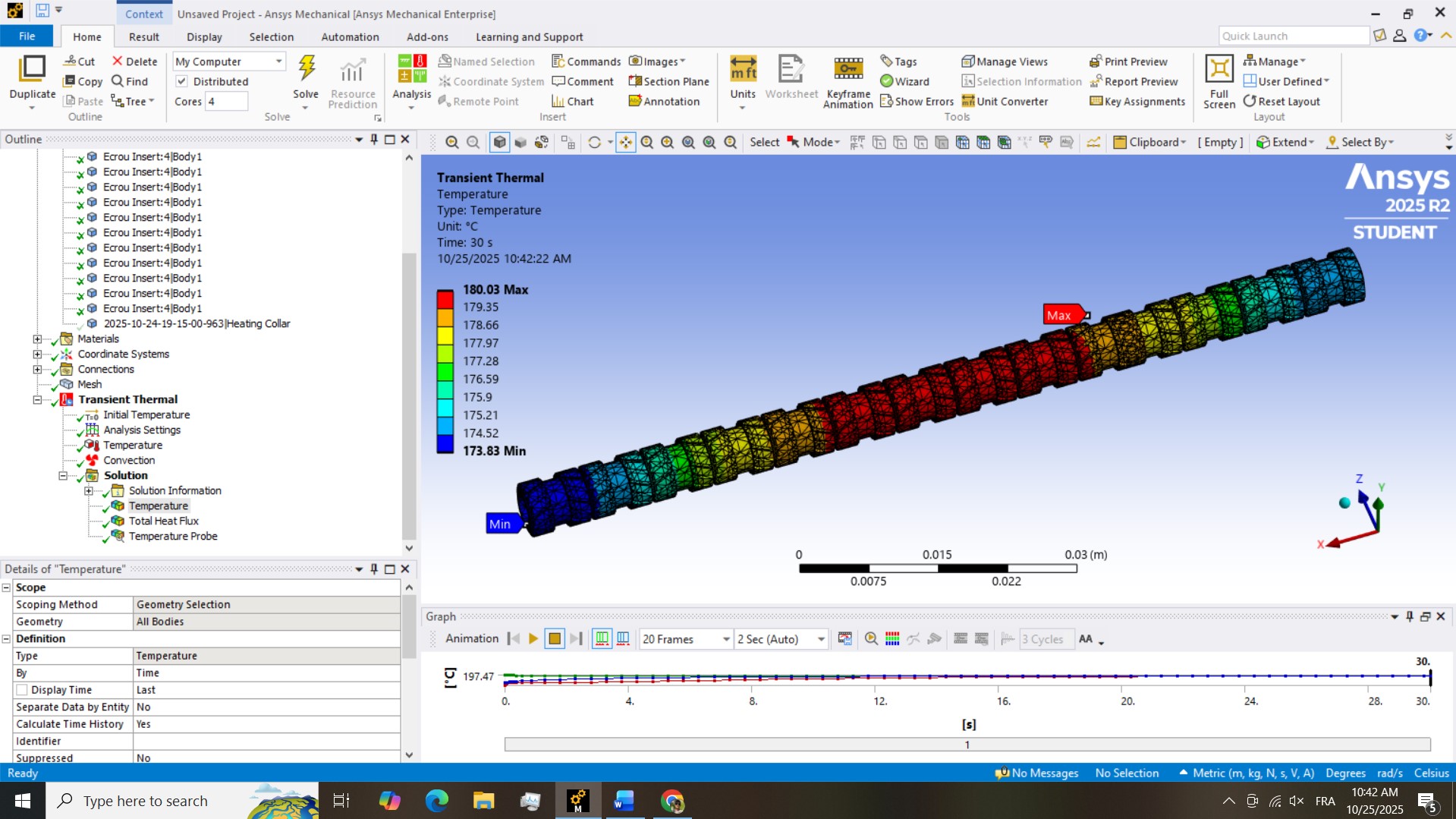
A high-fidelity numerical simulation (ANSYS Mechanical) accounting for transient heat transfer, actual 3D geometry, and contact thermal resistance.
$t_{\text{ANSYS}} = \mathbf{3.28\text{ s}}$
Découverte Clé : L'Écart
The FEA revealed significantly faster heating ($\approx$ 28.7% quicker) than the LCM predicted. Analysis of heat flux vectors (see gallery) confirmed that axial heat conduction between stacked nuts provided a major secondary heat path, a factor ignored by the simplified LCM.
Résultats et Découvertes
Galerie de Preuves Visuelles
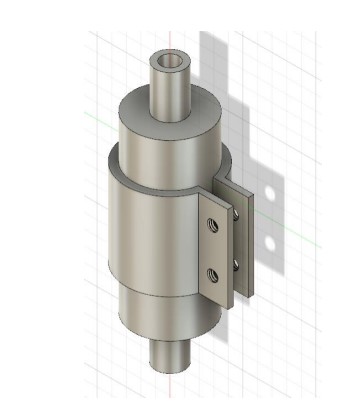
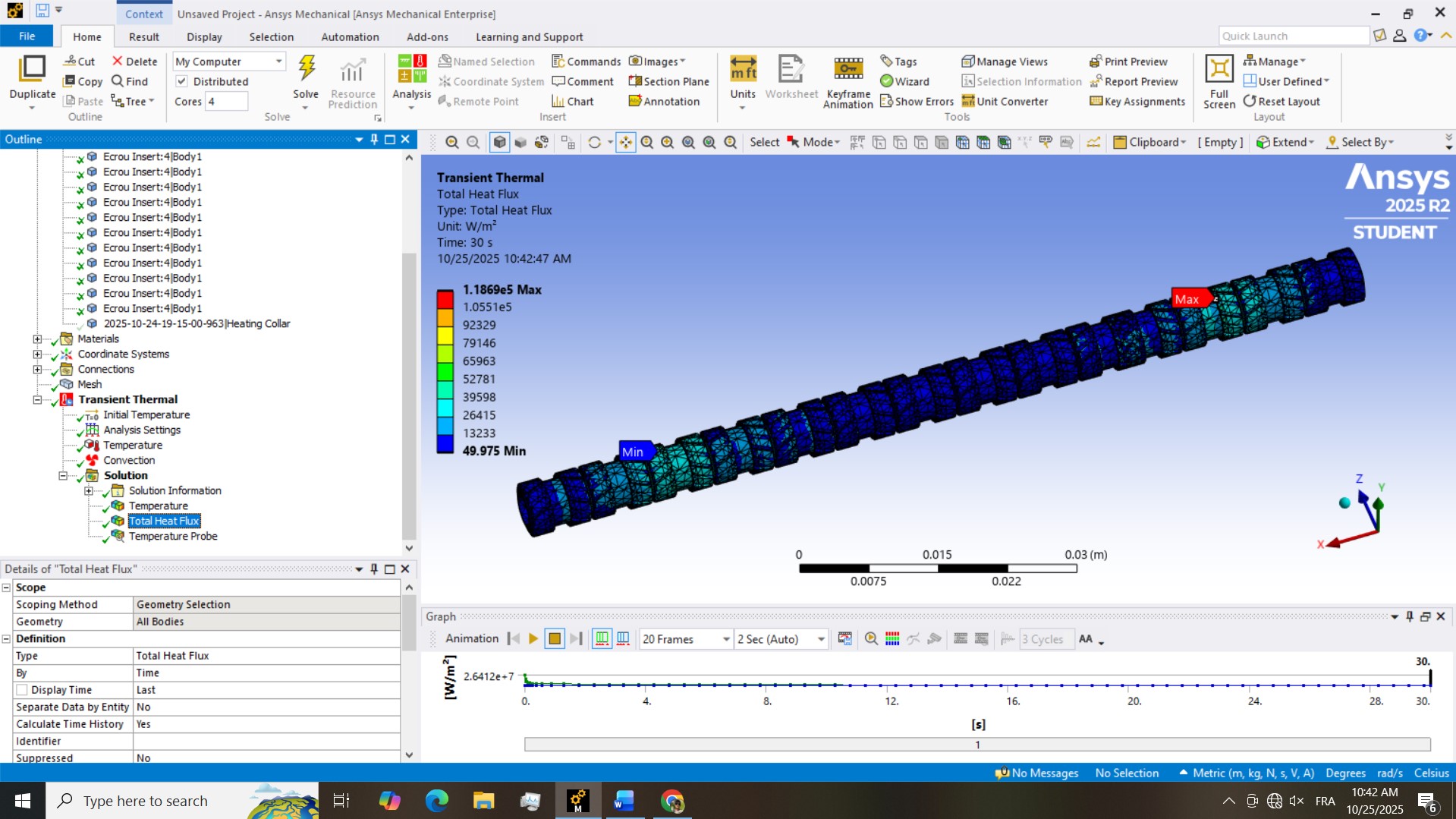
Résumé des Résultats Quantifiés
| Paramètre | $t_{\text{LCM}}$ (Theoretical) | $t_{\text{ANSYS}}$ (Validated FEA) | Erreur du LCM |
|---|---|---|---|
| Temps pour atteindre $170\degreeC$ | $4.22\text{ s}$ | $\mathbf{3.28\text{ s}}$ | +28,7 % (Surestimé) |
Impact en Ingénierie & Stratégie Finale
La contribution technique centrale de ce travail est la capacité de simplify the process control sur la base des données validées :
-
Validation de la cadence du processus : The validated heating time ($\mathbf{3.28}$ s) is far less than the cycle time (15 s), confirming heating is not a bottleneck.
-
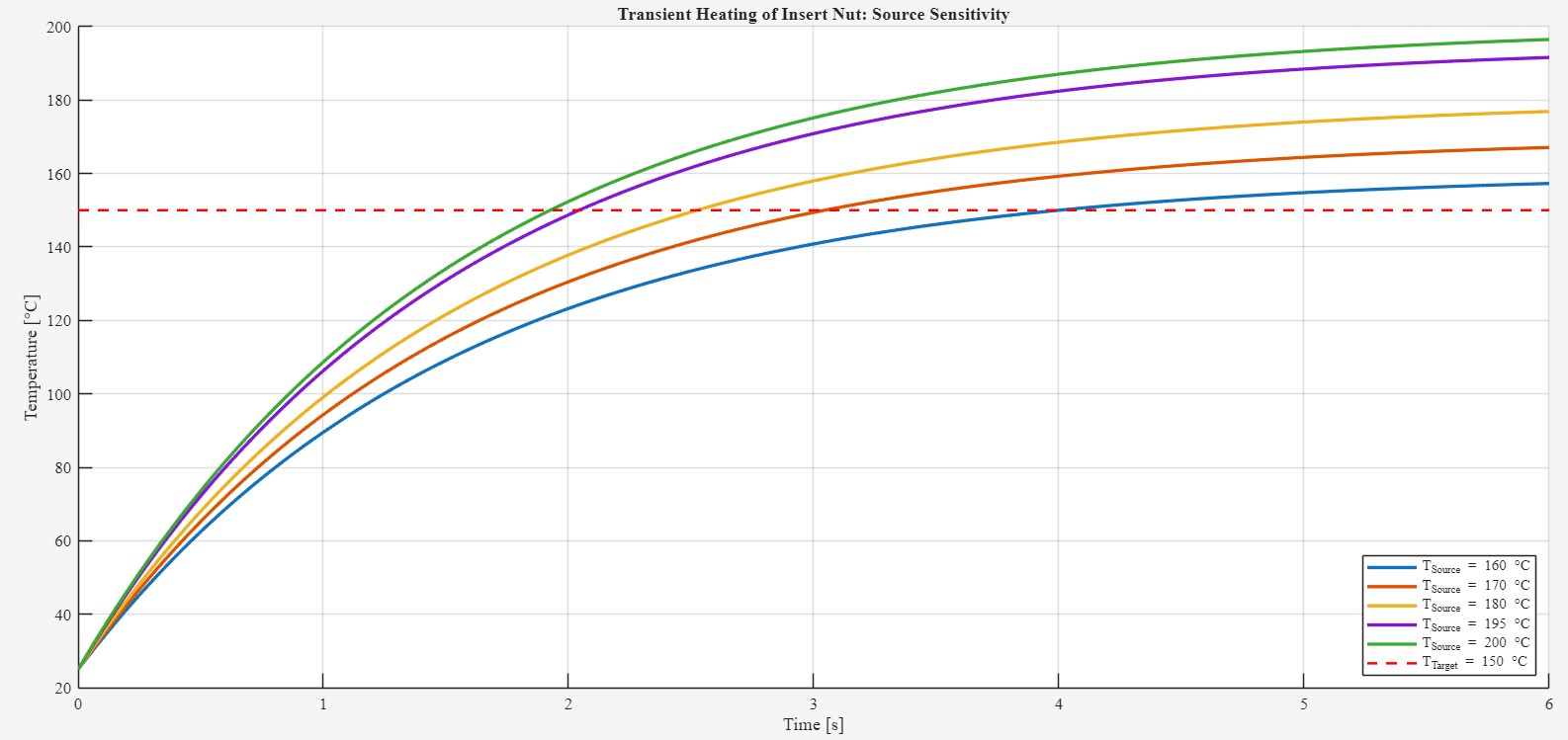
Simplified & Reliable Control Strategy: We implemented a robust strategy where the heating element is constantly ON, and safety is managed by limiting the source temperature ($T_{\infty} = 180\degreeC$) to prevent material degradation.
Recommandations et Travaux Futurs
A. Protocole de Validation Expérimentale Proposé
Recommended real-world test using high-speed thermal imaging (IR camera) and embedded thermocouples to validate $t_{\text{ANSYS}}$.
B. Investigation Future : Analyse Thermomécanique
Next step: Answer "What happens during physical insertion?" using a **Coupled Thermal-Structural Analysis** (Viscoplastic Material Model, Large Deformation).